
Gua Sha for Neck and Shoulder Tension
October 26, 2026
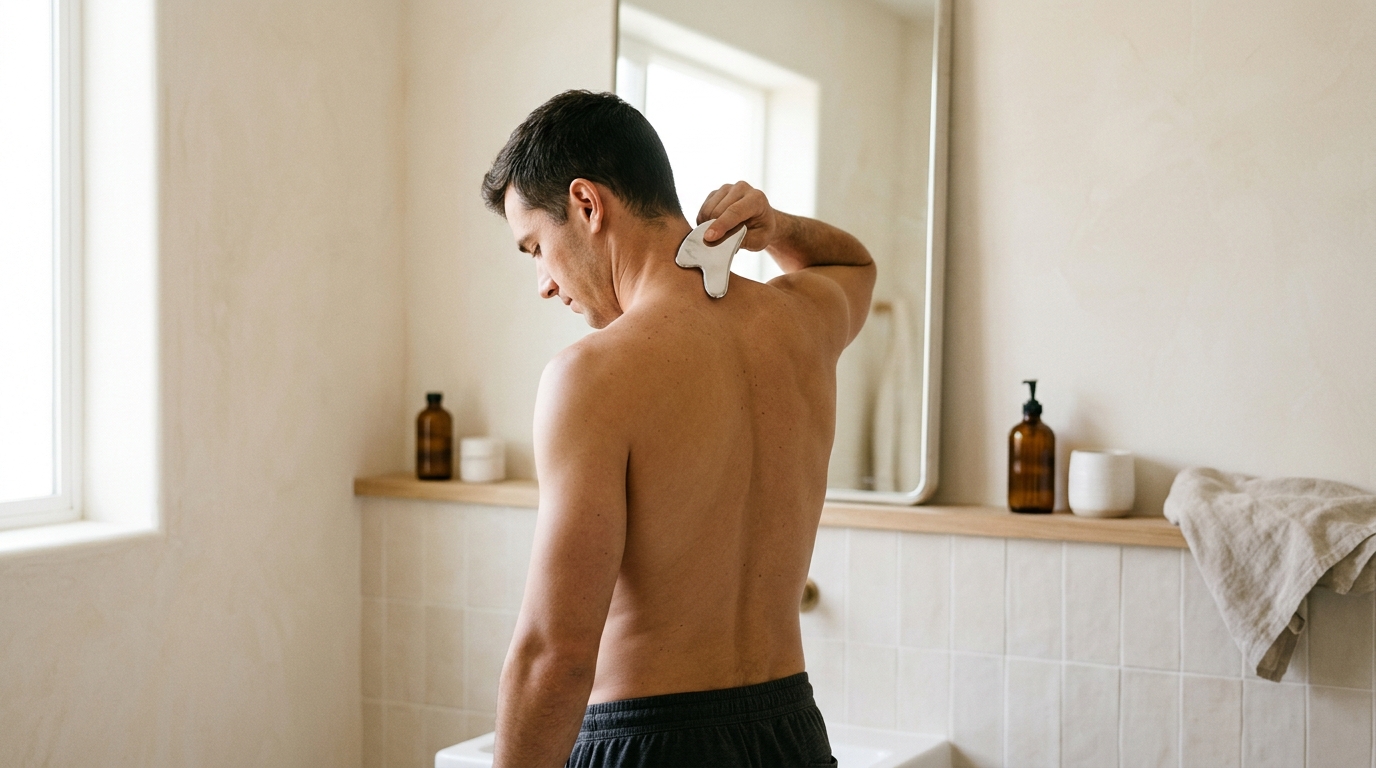
Gua Sha for Neck and Shoulder Tension
Most men hold tension in two places without realizing it: the jaw and the back of the neck. If you spend time at a desk, drive long stretches, or train with any kind of load on your upper body, the muscles along your cervical spine and across the top of your shoulders are likely working harder than they should be — and staying contracted longer than they need to.
Gua sha is one of the more effective ways to address this without booking a $150 sports massage every time. Here's how it works on neck and shoulder tissue specifically, and how to do it without causing problems.
What's actually happening in tight neck and shoulder muscles
When muscles stay contracted for extended periods — from sustained posture, repetitive motion, or stress — circulation in that tissue slows down. Metabolic waste (lactic acid, carbon dioxide) accumulates. You feel this as stiffness, aching, or that characteristic "knot" sensation that won't go away no matter how many times you stretch.
Gua sha works by applying firm, directional pressure across the surface of the skin, which increases local blood flow and moves fluid through the tissue. Studies measuring skin temperature and blood flow during gua sha have shown measurable increases in microcirculation that persist for hours after the session. Better circulation means waste moves out and fresh oxygen-rich blood moves in. The muscle can relax more fully.
This is the same mechanical principle as foam rolling or percussion massage — just applied with more precision and less force. If you've used a gua sha tool for face and jaw work before, the technique is adapted slightly for the larger muscle groups and different anatomy of the neck and shoulders.
Where to work: the key areas
Upper trapezius (across the top of the shoulder) — The most commonly tight muscle in desk workers and overhead athletes. Runs from the base of the skull out to the shoulder. This is usually the source of that constant dull ache across the top of your shoulders.
Levator scapulae (side of the neck, behind the ear) — A deep muscle that runs from the upper cervical vertebrae down to the shoulder blade. When tight, it creates a stiff, restricted feeling when you turn your head. Often overlooked in self-treatment.
SCM (sternocleidomastoid, front-side of neck) — Two thick bands that run diagonally from behind your ear down to your collarbone. Tension here can contribute to headaches and jaw tightness. Gua sha is one of the few self-treatment tools that can access this muscle meaningfully.
Sub-occipital muscles (base of skull) — Small muscles at the point where your skull meets your neck. Tension here is a primary driver of tension headaches. Work this area gently — the bone is close to the surface.
How to do it: technique
Use the Grooovie Steel Gua Sha Tool or the Grip Tool. You need a lubricant — face oil, body oil, or even unscented coconut oil. This protects the skin and allows the tool to glide rather than drag.
Position: Sit upright or stand. Tilt your head slightly in the direction you want to work to give the muscle more surface access.
Stroke direction: Always stroke downward (toward the heart) on the neck. On the upper trap, stroke outward from the spine toward the shoulder tip.
Pressure: Firm, not aggressive. You're trying to produce some redness (petechiae or "sha") which indicates increased blood flow — not bruising. If it's painful enough to make you wince, reduce pressure.
Speed: Slow and consistent. About one stroke every 2–3 seconds. Faster strokes are less effective at moving fluid.
Repetitions: 5–10 strokes per area before moving to the next section.
A basic neck and shoulder routine
This takes 8–10 minutes and covers the main areas of tension:
- Upper trap: Start at the base of the neck, stroke outward toward the shoulder tip. Do both sides. 5–8 strokes each side.
- Side of neck (levator scapulae / SCM area): Tilt your head to the opposite side for better access. Stroke from below the ear downward toward the collarbone. Light to moderate pressure. 5–7 strokes each side.
- Base of skull: Use the edge of the tool. Stroke downward from the occipital ridge toward the upper neck. Very gentle here — 4–5 strokes only.
- Between shoulder blades (rhomboid area): If you have a partner, they can work downward from the neck toward the shoulder blade. Solo, use a long-handled tool or work at an angle. 5–8 strokes.
After a session
Drink water. Gua sha increases circulation and can cause minor dehydration if you're doing extended sessions. The redness (sha) will fade within 24–48 hours — this is normal and isn't a sign that you've injured anything.
Some people feel immediate relief. Others notice it more the next morning once the tissue has had time to respond. Either is normal.
Frequency: 2–3 times per week for chronic tension is a reasonable starting point. Daily is fine for a lighter maintenance routine. If you're working on acute soreness from a hard training session, waiting 48 hours before working that area again gives the tissue time to recover.
What it won't fix
Gua sha is a recovery and circulation tool — it's not a substitute for addressing the root cause of the tension. If you're sitting in the same bad position for 10 hours a day, neck work will help manage symptoms but won't resolve the underlying issue. Same goes for structural problems, disc issues, or nerve impingement — those need a proper clinical assessment.
Used as part of a consistent recovery routine — alongside mobility work and good ergonomics — gua sha is one of the better tools available for neck and shoulder maintenance. It's cheap, portable, and once you learn the technique, takes less time than a foam roll session.
If you haven't already, it's worth reading through how to maintain and store your tool — especially if you're adding neck work to your routine, since you'll be using it on skin that's in contact with your hairline and jaw.