
Gua Sha vs Face Roller: What's the Difference and Which One Should You Use?
October 6, 2026
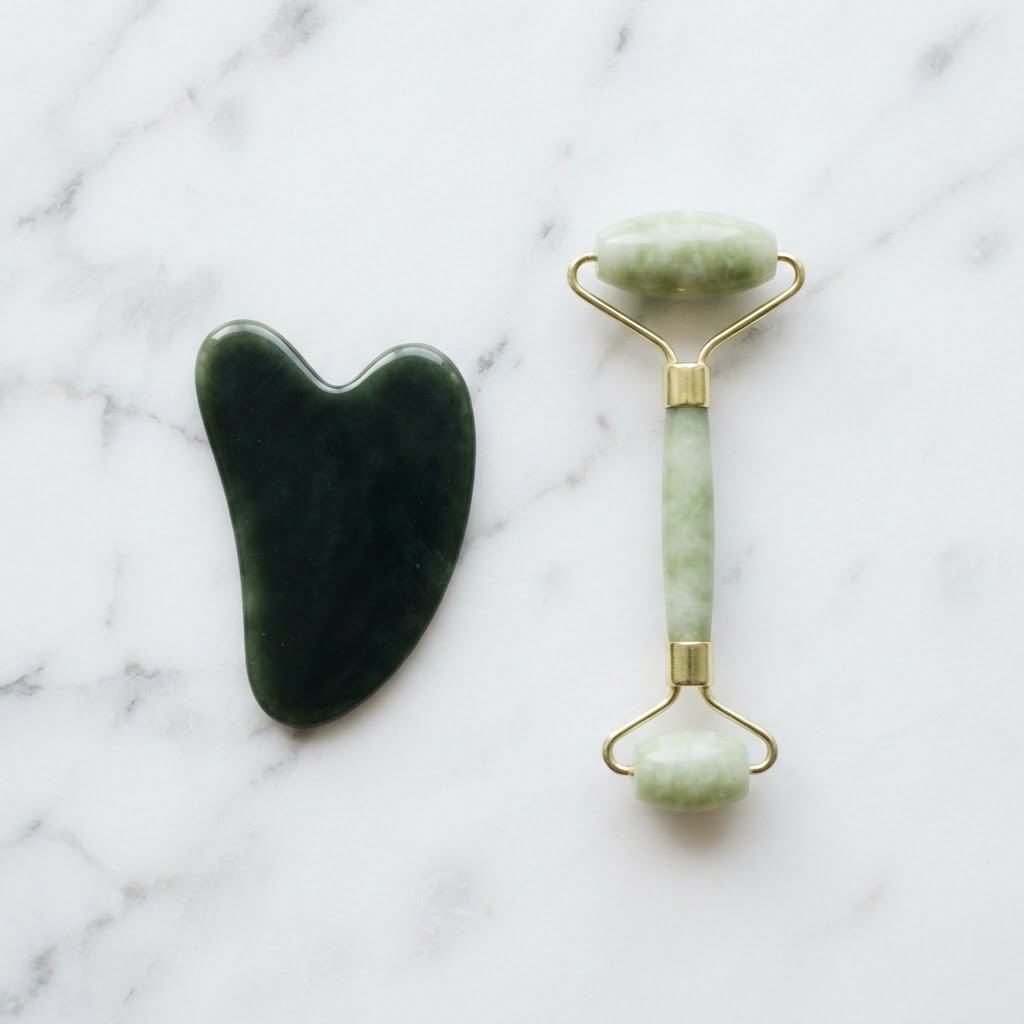
Gua sha and face rollers show up in the same search results, sit next to each other on the same shelves, and get recommended in the same skincare articles. They are not the same tool, they do not work the same way, and they produce different results.
If you are deciding between them — or wondering whether you already own the right one — here is a direct comparison with no hedging.
How They Work
Gua Sha
A gua sha tool is a flat, curved tool used in short, firm strokes across the skin. The technique applies directed pressure along the contours of the face — you are actively working the tissue. The strokes stimulate lymphatic drainage, increase circulation, and when applied to the jaw and temples, release muscle tension.
The technique has a learning curve. The first two to three sessions, you are figuring out angle and pressure. By session four or five, it becomes automatic. After that it is a five-minute routine.
Face Roller
A face roller uses a rolling cylinder — typically jade or rose quartz — that glides across the skin with minimal resistance. It requires almost no technique. You roll it across your face in outward strokes and it stimulates circulation and mild lymphatic drainage.
The experience is immediately pleasant. The cooling effect of the stone, the gentle pressure, the low cognitive load. It is the easier tool by a significant margin.
Results: Side by Side
| What you want | Gua Sha | Face Roller |
|---|---|---|
| Morning puffiness reduction | Strong — directed drainage is fast and visible | Moderate — helps move fluid but less precisely |
| Jawline definition | Yes, with consistent use over 4-8 weeks | Minimal — not enough pressure to reshape |
| Jaw and neck tension | Strong — works the muscle tissue directly | Minimal — not enough pressure to release muscle |
| Skin circulation and glow | Strong | Moderate |
| Under-eye puffiness | Strong, with correct light-pressure technique | Moderate, especially when chilled |
| Ease of use | Learning curve of 2-3 sessions | Immediate — no technique required |
| Time per session | 5-10 minutes | 3-5 minutes |
| Tension headache relief | Effective at forehead and temples | Mild, from cooling effect only |
The Honest Recommendation
Use gua sha if: you want functional results from your skincare routine. Jaw tension, puffiness reduction, jawline definition, skin tone improvement. You are willing to learn a simple technique and spend five minutes on it most days.
Use a face roller if: you want something that requires zero technique and delivers a pleasant sensory experience. It is not a substitute for gua sha in terms of results, but it is better than nothing and it genuinely feels good — especially stored in the fridge and used on a hot morning or after a long flight.
Use both if: you want to layer the benefits. Roller first to warm up the skin and begin the drainage process, gua sha second for the deeper work. Some people do this. It takes about twelve minutes combined. The results are additive.
The Grip Problem (Specific to Gua Sha)
The main reason people abandon gua sha in favor of a roller is not technique or results — it is that the gua sha tool slips in their hand once oil is involved. Most tools have a smooth polished back face, and the moment oil transfers from your skin to your hand, you lose grip.
This is why the Grooovie tool has grip grooves machined into the back face. The grooves break the oil film and give your fingers something to catch even mid-stroke. If you have tried gua sha before and found it frustrating to hold, this is likely the issue — and it is a design problem, not a technique problem.
What the Research Says
Clinical research on gua sha is limited but the existing studies show measurable increases in surface microcirculation and some evidence of anti-inflammatory effects from the technique. The lymphatic drainage mechanism is well established in manual therapy research, though gua sha specifically has fewer controlled studies than some other manual techniques.
Face rollers have even less clinical research. The effects are real but milder, and most of the evidence is observational and practitioner-reported rather than controlled.
Neither tool has robust RCT evidence for cosmetic outcomes specifically. The practical evidence — from consistent daily use over weeks and months — is what most people are actually relying on.
Bottom Line
If you only own one tool and you want results, get a gua sha tool. The technique takes a few sessions to learn and then it is fast, effective, and sustainable.
If ease of use and sensory experience are the priority, a face roller is a reasonable choice — just set expectations for what it can and cannot do.
The beginner's guide to gua sha technique is a good place to start if you are new to it. And the Grooovie tool solves the grip problem that stops most people from sticking with gua sha long enough to see results.